If you are an independent practitioner, you may have been told that you cannot possess a Gohonzon without joining a large organization. You might have heard that without a priest's permission, your altar is "unofficial" or "counterfeit."
This is not true. The Gohonzon is a tool for your own enlightenment, not a membership card.
Here are the three legitimate ways to receive a Gohonzon independently, ensuring you respect the tradition while maintaining your freedom.
Path 1: The Official Route (Member-at-Large)
This is the safest option if you want a "consecrated" scroll from a legitimate lineage but do not want to deal with local politics or meetings.
-
Who it is for: People who want an official connection without the social obligation.
-
The Provider: Nichiren Shu (via the NBIC - Nichiren Buddhist International Center).
-
The Process:
-
Go to the NBIC website and apply for "Member-at-Large" status.
-
Pay the annual membership fee (approx. $140).
-
Once accepted, request the "Shutei Gohonzon".
-
Pay a separate donation (Gokuyo), typically $50–$100.
-
They will mail you a consecrated scroll. You never have to attend a meeting.
-
Path 2: The Restoration Route (The 1277 Protocol)
This is the "DIY" path for the digital age. It utilizes a high-resolution scan of a Gohonzon inscribed by Nichiren Daishonin himself for a lay believer.
-
Who it is for: The "Digital Ronin" who wants zero institutional ties.
-
The Source: The "Prayer Gohonzon" of 1277.
-
The Process:
-
Download: Download the high-resolution scan of the 1277 Prayer Gohonzon here from our Google Drive.
-
Print: Do not use a home office printer. Take the file to a professional print shop.
-
The Specs: Request Giclée printing on Washi (rice paper) or heavy Cotton Archival paper. This respects the sanctity of the object.
-
Mount: Frame the print in gold or place it in a traditional scroll mount. Treat it like a diamond, not a poster.
-
Path 3: The Direct Route (The Kanji Hack)

This method helps you find local, authentic temples in Japan that are often willing to support sincere foreigners, bypassing the "tourist" traps.
-
Who it is for: Those who want a direct connection to a temple in Japan.
-
The Problem: Searching "Nichiren Temple" in English only shows tourist spots or SGI centers.
Using the "Kanji Hack" method you described, I have located several verified Nichiren Shu (日蓮宗) temples in the key historical hubs of Japan. These are authentic, functioning temples (often with cemeteries attached) that fit your criteria.
1. Kamakura (The Birthplace)
Kamakura is one of the best places to start because of its deep historical connection to Nichiren Daishonin.

-
Myohon-ji Click to open for more information
-
Address: 1-chōme-15-1 Ōmachi, Kamakura, Kanagawa 248-0007, Japan
-
Why it fits: This is one of the oldest and most significant Nichiren Shu temples. It is a "working" temple surrounded by peaceful gardens, distinct from the crowded tourist spots. It has a strong historical lineage.
-

-
Ankokuron-ji Click to open for more information
-
Address: 4-chōme-4-18 Ōmachi, Kamakura, Kanagawa 248-0007, Japan
-
Why it fits: This site is where Nichiren is said to have written the Rissho Ankoku Ron. It is a smaller, historically dense temple that matches the "authentic" criteria.
-

-
Hongaku-ji Click to open for more information
-
Address: 1-chōme-12-12 Komachi, Kamakura, Kanagawa 248-0006, Japan
-
Why it fits: Centrally located but authentic, known for holding the ashes of Nichiren Daishonin.
-
2. Minobu (The Head Temple)
If you are looking for the "source," this is the most direct route.

-
Minobusan Kuon-ji Click to open for more information
-
Address: 3567 Minobu, Minamikoma District, Yamanashi 409-2593, Japan
-
Why it fits: This is the Head Temple of Nichiren Shu. It is a massive complex but deeply authentic. While it attracts pilgrims, it is the standard for orthodox practice and certainly not a "tourist trap" in the secular sense.
-
Tip: Because it is the headquarters, they are very accustomed to foreign visitors, though the "small temple" vibe will be different here.
-
3. Kyoto (Historic Hub)
Kyoto has many temples, but you must be careful to distinguish between lineages.

-
Address: 514 Myōkenjimaechō, Kamigyo Ward, Kyoto, 602-0005, Japan
-
Why it fits: A prominent head temple of a Nichiren lineage, often quieter than the major tourist Zen temples in Kyoto.

-
Ryūhon-ji Temple Click to open for more information
-
Address: 107 Ichibanchō, Kamigyo Ward, Kyoto, 602-8345, Japan
-
Why it fits: Another of the historic "Eight Head Temples" of Nichiren Buddhism in Kyoto.
-
⚠️ Important Warning for Your Search
When you perform the search using 日蓮宗 (Nichiren Shu), the map also returned results for Nichiren Shoshu (e.g., Gokokuji in Kamakura, Heian-ji in Kyoto).
-
The Trap: The Kanji for Nichiren Shoshu (日蓮正宗) contains the Kanji for Nichiren Shu (日蓮宗).
-
How to spot the difference: Look closely at the name on Google Maps. If you see the extra character 正 (Sho) in the middle, it is Nichiren Shoshu (the priesthood associated with the SGI split).
-
Your Target: Ensure the name is strictly 日蓮宗 (Nichiren Shu) or associated with the temples listed above.
How do I find a Nichiren Shu temple near me in order to request a Gohonzon?
Let's pretend you're from Miami. To search for a Nichiren Shu temple in Miami using Google Maps, you must be very specific because Google's algorithm often confuses different Nichiren lineages.
Here is exactly what to do and, most importantly, what to watch out for.
1. The Exact Search Query
Open Google Maps and type this exact phrase:
"Nichiren Shu Temple"
Do not just type "Nichiren Buddhism" or "Buddhist Temple," as this will return results for every denomination (Zen, Theravada, etc.).
2. The "False Positive" Warning (Crucial for Miami)
In Miami specifically, when you search for "Nichiren Shu," Google Maps will likely show you this result first:
Warning: This is Soka Gakkai International (SGI). While they practice Nichiren Buddhism, they are a lay organization separate from the traditional Nichiren Shu lineage. If you are looking for a temple with priests and the traditional liturgy (as discussed in Path 1 or Path 3 of your guide), this is not it.
You might also see results for Nichiren Shoshu (e.g., in other parts of Florida). Note that Nichiren Shu (Day Lotus School) and Nichiren Shoshu (Orthodox School) are separate sects with different doctrines.
3. How to Verify the Result
Since there are very few dedicated Nichiren Shu buildings in Florida compared to California or Hawaii, you must check the name carefully:
-
Look for: "Nichiren Shu" (specifically "Shu").
-
Avoid: "SGI", "Soka Gakkai", or "Shoshu" if you are strictly seeking the traditional lineage.
4. What if there are 0 results?
If Google Maps returns no specific Nichiren Shu temples in Miami (which is likely, as they may not have a dedicated building there), this confirms you are a prime candidate for Path 1 (Member-at-Large).
-
Instead of a physical building, you would connect with the Nichiren Buddhist International Center (NBIC) online, which supports practitioners in areas like Miami where no physical temple exists.
The "Gogan-sho" Template
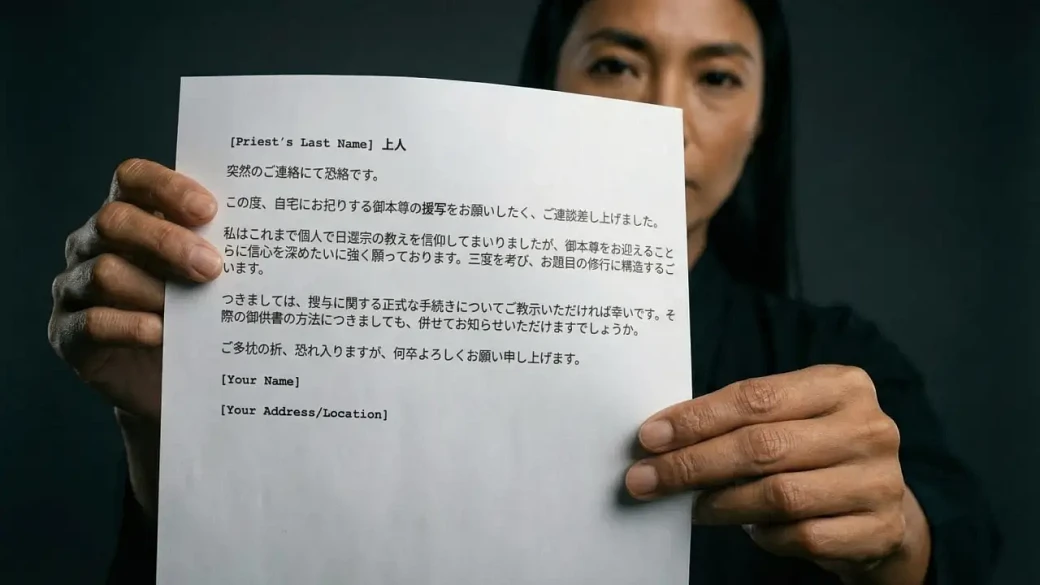
Once you have located a potential temple using the method above, the next step is to make contact. Since most traditional temples do not have English-speaking staff, sending a casual email in English often results in silence.
To be taken seriously, you must send a Gogan-sho (御願書).
What is a Gogan-sho?
A Gogan-sho is not merely a letter; it is a formal petition used to request a sacred object or service. In Japanese culture, the way you ask is just as important as what you ask. Using the correct format demonstrates that you understand the gravity of receiving a Gohonzon and that you respect the temple's tradition.
Why use this template?
We have created a pre-written template using formal "Keigo" (honorific Japanese). This creates a bridge of respect. It tells the priest, "I may be a foreigner, but I have approached this with the sincerity and politeness of a Japanese practitioner." It removes the language barrier and ensures you do not inadvertently cause offense.
Step 1: Get the Template We have hosted the template on Google Drive so you can easily edit it.
-
Click here to open the Gogan-sho Template in Google Drive.
-
Go to File > Make a copy to save it to your own drive.
-
Replace the bracketed sections (Priest's Name, Your Name, Your Address) with your information.
-
Print the letter on clean, high-quality white paper.
Step 2: The Envelope (Crucial Step) How you prepare the envelope determines whether your letter is opened immediately or set aside. To ensure your petition arrives safely and is treated with urgency, follow these rules:
-
The Address: Write the temple's address clearly in English (or Japanese if you can copy-paste it).
-
The "Secret" Code: On the front of the envelope, in the bottom left corner (or next to the address), use a Red Pen to write the following Japanese characters: 御願書在中 (Pronunciation: Gogan-sho Zaichu) Meaning: "Petition Enclosed"
This acts like a "Priority Mail" stamp for the priest. It signals that the envelope contains a formal religious request, distinguishing it from bills, advertisements, or general inquiries.
-
The Recipient: If you know the priest's name, write: [Name] Shonin. If you do not know the name, write: Gojushoku-sama (To the Head Priest).
By following this protocol, you are signaling that you are a serious practitioner ready to enter the "Direct Route."